There are two types of people reading this post. The first is anyone who comes across my blog from knowing me, stumbling upon me, or maybe even some random SEO that had Google point you my direction.
But the other type of person is most likely the FTF (First-To-Find), a recently hidden geocache called Dad’s Favorite Things. Many Geocachers try to include some kind of bigger and more fun “prizes” for the first one to come across a newly placed cache. This particular one is FULL of things that are my favorite, and I thought the ham radio hobby might co-exist or at least pique some interest for a fellow cacher. So here YOU are- welcome! I will direct the rest of the post to you, the lucky FTF. But everyone else is welcome to stay and learn about geocaching, too.
First, the story
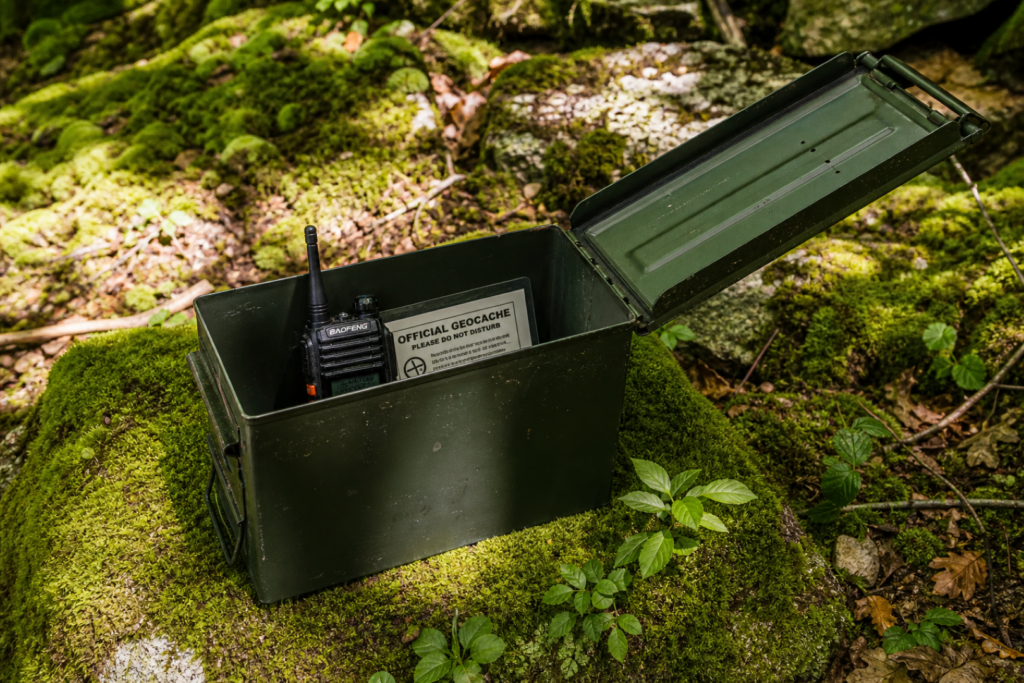
“Dad’s Favorite Things” is my Father’s Day 2026 cache, except I did not build it or hide it by myself. My kids helped a lot! They packed a container with a few things I am into and stashed it at a spot close to where our family spends a lot of time.
What the card told you
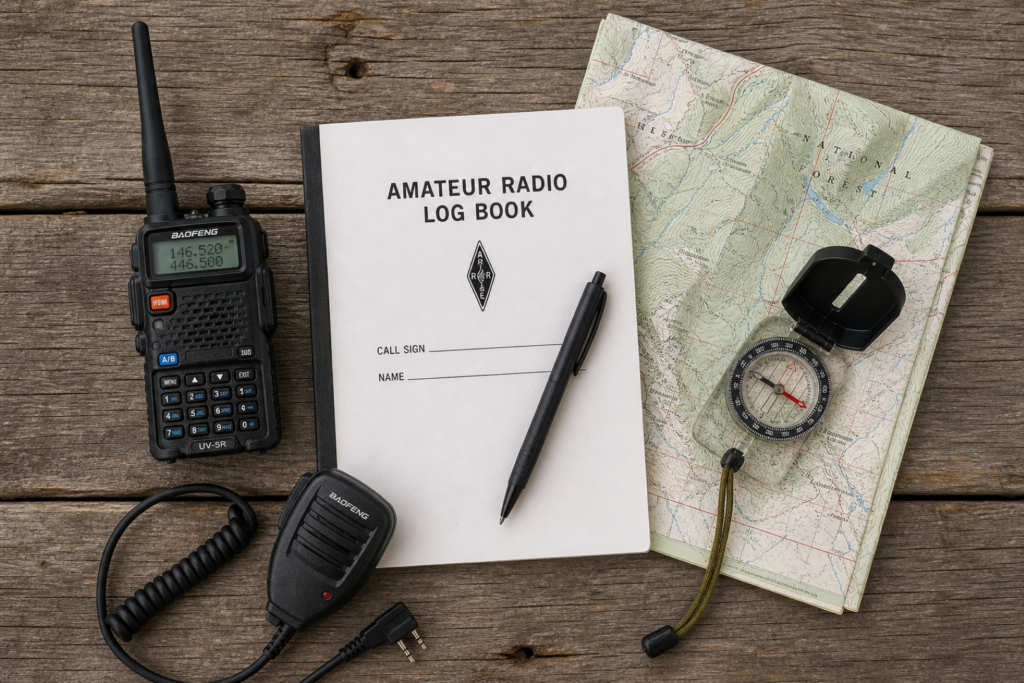
Short version, in case you left the card in the cache. It is a Baofeng UV-5R Mini, already programmed for the Indianapolis area. The channels are grouped: local 2-meter repeaters, the 440 repeaters, SKYWARN spotter repeaters, NOAA weather, the FRS and GMRS channels your neighbors use on hikes, and a block of railroad frequencies if you like trains.
Working it is simple. Turn the top knob to switch it on and set the volume. Tap the V/M key until a channel number shows on the screen. Type a three-digit channel, or use the arrow keys to move around. You can also press the MENU button, select SCAN from the screen, and it will attempt to go through all of the channels over and over, until a signal is heard.
You can listen to anything, anytime, no license needed. Transmitting is the part the law cares about, and that takes a license. So spin the dial and eavesdrop on your whole town. Just do not key up (pressing the PTT button on the side) the talk button unless you are licensed.
What ham radio actually is
It is a hobby and an emergency service that happens to share the same gear. On a quiet night, it is people chatting through a repeater across town, or bouncing signals off the upper atmosphere to reach someone in another country with no internet in between. When a storm knocks the grid out, and your phone shows no bars, it is often the thing still working. The FCC has licensed it for more than a hundred years, and there are still hundreds of thousands of operators on the air in the US.
I will be honest about the radio in your hand: a Baofeng is cheap, a little clunky, and the menu system is famously annoying. That is also why it is the perfect first radio. You can drop it, soak it, lose it in a creek, and you are out a small amount of money instead of a small fortune. Most of us started here.
The part you are going to love
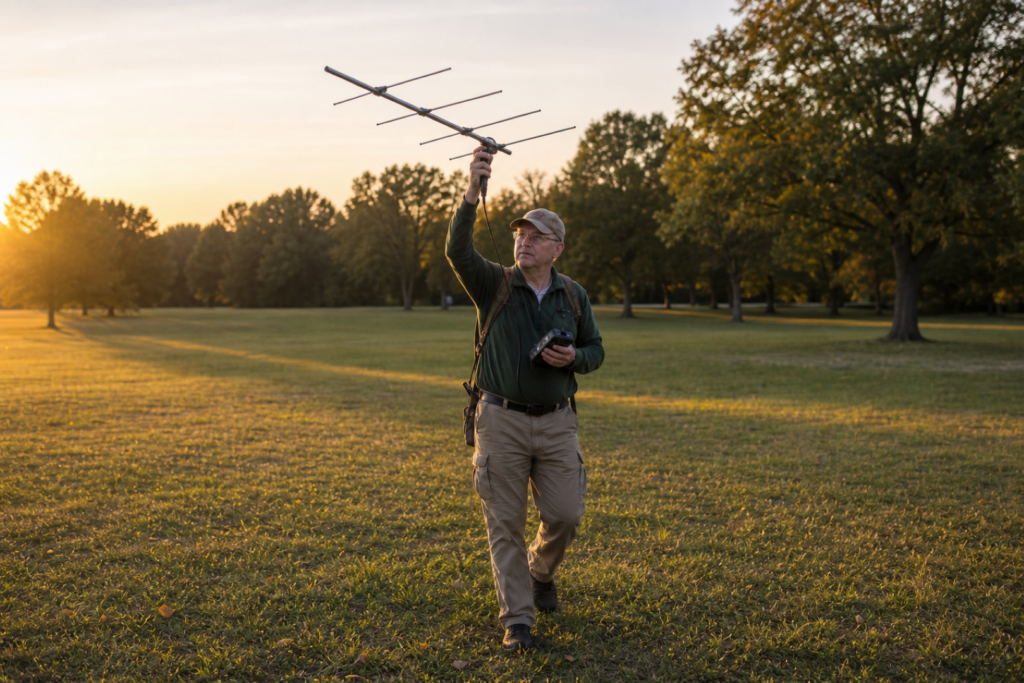
Here is what I tell every geocacher who asks. There is a whole branch of this hobby that is geocaching with the coordinates taken away. It is called foxhunting. One person hides a small transmitter somewhere inside a boundary, flips it on, and the rest of us go find it with nothing but the signal to guide us.
No GPS. No little green icon on a map. You hold up a directional antenna, listen to how loud the beeping is, turn your body, and chase the strongest reading until you are standing on top of a transmitter the size of a deck of cards taped under a park bench. It is maddening in the best way. The signal bounces off buildings and lies to you. Your first three bearings point in three different directions, and then it suddenly all clicks, and you are running. Ham clubs all over the country run these, on foot in a park or mobile across a whole county, and more than one of them flat-out calls it “geocaching for radio geeks.” They are right.
Other ways we end up outside
If you like being out in the woods with a purpose, you will fit right in. Parks on the Air, POTA for short, is hams setting up a portable station at a picnic table and working the world for an afternoon. Pair it with a caching run, and you have a full day.
You might want to check out ARRL Field Day as well, typically towards the end of June every year. It is the biggest day on the calendar, when tens of thousands of operators drag radios, antennas, and batteries out to fields and parking lots to see how far they can reach in 24 hours on no commercial power. It is half contest, half cookout. Show up at a local site, tell them you found a radio in a geocache, and someone will happily hand you a microphone and walk you through your first contact.
Getting your own license
If listening makes you itch to talk back, the door is wide open. The entry-level Technician test is 35 multiple-choice questions, no Morse code, and the entire question pool is published ahead of time. You are studying from the real answers. Around Indianapolis, you can find exam sessions in person and online most weeks, and they are cheap to sit for, often free. The only fixed cost is a one-time 35-dollar fee to the FCC after you pass, which gets you your call sign and ten years on the air.
I keep a running list of the study tools and exam resources I actually trust at themann00.com/ham-study-guides. Start there.
GMRS vs Ham
If you started poking around the FRS and GMRS channels on this radio, you have already met ham radio’s simpler cousin. GMRS is the other way to talk without cell service, and it is worth knowing the difference before you decide which license to chase.
GMRS skips the test. You apply online, pay a one-time $35 fee, and the license covers your whole immediate family for ten years. It runs on 30 fixed UHF channels, FM voice only, with handhelds in the 1 to 5 watt range and mobile units up to 50. Range is mostly line-of-sight, so figure a mile or two between handhelds in a neighborhood and more if you can hit a tall repeater. It is built for trail rides, camping, road trips, and family backup when the phones quit.
Ham asks more and gives more. You pass a written exam instead of paying for the license, but you get vastly more frequencies, far more power, and the freedom to use repeaters, HF skywave, satellites, digital modes, and homebuilt antennas. GMRS keeps it simple, ham lets you experiment and reach much further.
The honest answer for a lot of people is both. GMRS gets the family talking this weekend, and ham becomes the long-term hobby. I broke the whole comparison down- license, range, gear, cost, and legal limits- in a full writeup here: Ham Radio vs. GMRS: Which Should You Choose?
So, congrats to you, FTF’er
Turn it on. Listen to your town for a week or two. If it gets its hooks in you the way it got me, go pass that easy test and find me online at N9MAN.com.
Then key up and say hello. I will be listening.
73, N9MAN, Jacob “@TheMann00” Mann

Read more about what I have to say about AI on my Substack.